 By
By An LED lightbox is an illuminated sign that lights up a printed graphic from behind, using rows of energy-efficient LED bulbs housed inside a slim aluminium frame. Instead of relying on external spotlights or streetlamps to make your shopfront visible, the light comes from within the sign itself — which is exactly why LED lightboxes have become the go-to signage choice for shops, restaurants, clinics, and offices across Malaysia.
If you’ve ever walked past a glowing storefront at night and wondered how the whole panel seemed to shine so evenly, you were probably looking at an LED lightbox. Let’s break down what’s actually happening inside that box.
What Is an LED Lightbox, Exactly?
Strip away the marketing language, and an LED lightbox is really just three things working together: a frame, a light source, and a translucent graphic panel.
The frame — usually aluminium — holds everything in place and gives the sign its shape. Behind the printed face, rows of LED modules sit evenly spaced apart, throwing light forward. And the graphic itself is printed on a light-permeable material, often fabric, acrylic, or duratrans film, so the light can pass through it and bring the design to life.
Put those three parts together, switch on the power, and you get a sign that looks sharp in daylight and glows brilliantly once the sun goes down. That’s the whole idea behind an LED lightbox — one panel, two jobs: display your branding and light it up.
How Does an LED Lightbox Actually Work?
Here’s where it gets interesting. It’s not just about sticking a bulb behind a picture. The way the light spreads out determines whether your sign looks crisp and even — or patchy and unprofessional.
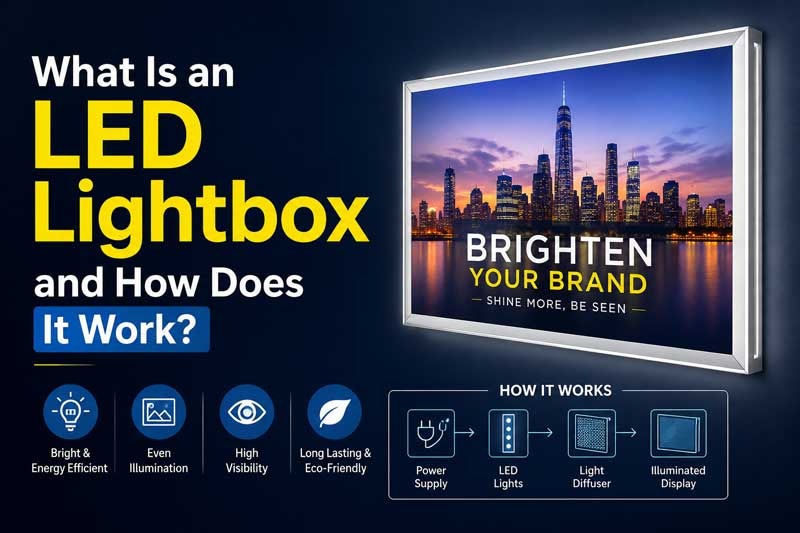
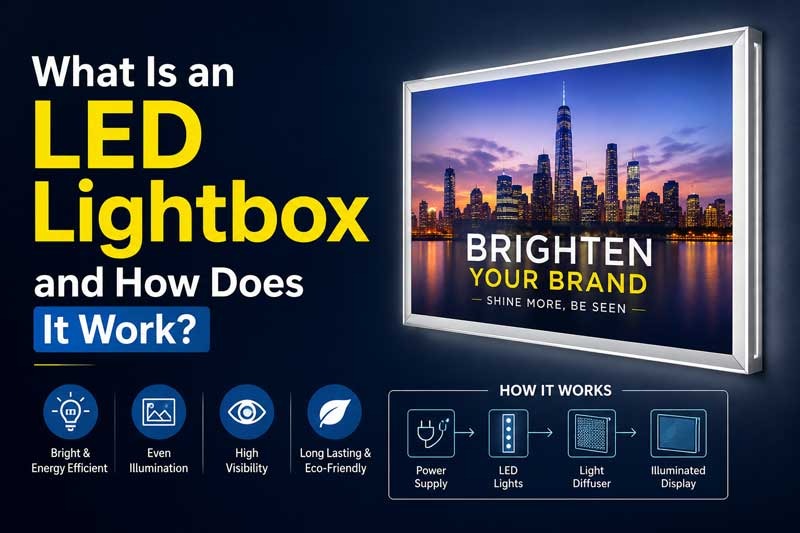
Step 1: The LED modules generate light.
Small LED strips or chips are mounted on a backboard or along the inner edges of the frame. Unlike old fluorescent tubes, LEDs give off very little heat and use a fraction of the electricity.
Step 2: The light travels and spreads.
Depending on the design, the light either bounces off the back panel and fans outward (backlit), or it travels along the edges of the box and refracts across the whole surface through a special acrylic sheet (edge-lit).
Step 3: A diffuser evens everything out.
This is the step most people never think about, but it’s the one that makes or breaks the final look. Without a diffuser layer, you’d see distinct bright spots wherever an LED sits — instead of one smooth glow. A good lightbox spaces its LEDs correctly and uses the right diffusing material so the brightness looks uniform from edge to edge.
Step 4: The graphic lights up.
The printed face — your logo, your menu, your promotion — sits in front of all this and gets illuminated evenly, making colours pop and text stay legible from a distance, day or night.
That combination of even spacing, correct depth, and quality diffusion is really the whole engineering challenge behind a well-made LED lightbox. Get it wrong, and you end up with a sign full of visible hotspots. Get it right, and it looks like the graphic is glowing on its own.
Backlit vs Edge-Lit: Which One Are You Looking At?
Not every LED lightbox works the same way, and this is where a lot of business owners get confused when comparing quotes.
A backlit LED lightbox places the LED strips directly behind the graphic, spread out in rows. It usually needs more depth in the frame to let the light diffuse properly before it reaches the face — think of the classic shopfront lightbox you see running along the top of a row of shops.
An edge-lit LED lightbox tucks the LEDs along the outer edge of a clear acrylic sheet. Light enters from the sides and travels through the panel using total internal reflection, spreading out across the whole surface. This is what makes ultra-slim LED lightboxes possible — some as thin as 25mm — because you don’t need the extra depth a backlit design requires.
If you’re after a bold, high-lumen shopfront sign, backlit usually wins. If you want a sleek, modern, space-saving display for an office lobby or retail counter, edge-lit is often the better call.
The Different Types of LED Lightbox Signage
Once you understand the basic mechanics, it’s easier to see why there are so many variations on the market:
- Slim LED lightboxes – thin, wall-mounted frames ideal for shopfronts and mall units
- SEG (silicone edge graphic) fabric lightboxes – a seamless, frameless look using tensioned fabric graphics, popular in retail and exhibitions
- Acrylic LED lightboxes – rigid, glossy panels with strong colour vibrancy, common for reception areas and clinics
- Outdoor LED lightboxes – weatherproofed and sealed to handle Malaysia’s heat, humidity, and monsoon rain
- A2 and A3 LED lightbox stands – portable, freestanding units perfect for menus, promotions, or event signage that needs to move around
Each type solves a slightly different problem, but they all rely on the same core principle: even, energy-efficient illumination from behind or beside the graphic.
Why Malaysian Businesses Keep Choosing LED Lightboxes
Malaysia’s climate and business landscape make LED lightboxes a particularly smart investment. Here’s why so many shop owners, from Shah Alam to the Klang Valley, are switching over:
They cut electricity costs. LED technology uses significantly less power than the old fluorescent tubes that used to sit behind shop signs, and LED modules can run for tens of thousands of hours before needing replacement.
They stay visible around the clock. A well-lit sign doesn’t lose its impact after sunset — which matters when foot traffic and driving traffic both peak in the evening across most Malaysian commercial strips.
They handle the heat and humidity. Quality outdoor LED lightboxes are built with sealed, weather-resistant housings that hold up against tropical downpours and constant sun exposure, so you’re not repainting or replacing your sign every year.
They’re easy to refresh. Many lightbox frames open from the front, so swapping in a new graphic for a promotion or rebrand takes minutes, not a whole new installation.
Bringing It All Together
An LED lightbox works by pairing efficient LED illumination with a carefully engineered frame and diffuser system, so your signage stays bright, even, and eye-catching in every kind of weather and lighting condition. Whether you’re weighing up a slim wall-mounted unit for your shop entrance or a full outdoor lightbox for round-the-clock visibility, understanding how the light actually travels through the box helps you ask the right questions before you commit to a supplier.
At Elite Sign Advertising, we design and fabricate the full range of LED lightbox signage in-house — from slim and SEG fabric lightboxes to fully custom outdoor installations — for businesses across Shah Alam, Selangor, and beyond. If you’re ready to see how an LED lightbox could work for your storefront, explore our LED lightbox signage services or reach out for a free consultation.