You’ve narrowed your shopfront signage down to two options: an LED lightbox or a neon sign. Both look great in photos. Both catch the eye at night. But LED lightbox vs neon sign isn’t really a style debate — it’s a business decision that affects your electricity bill, your maintenance costs, and how long your sign lasts in Malaysia’s heat and humidity.
This guide breaks down exactly where each option wins, so you can pick the right one for your shop, restaurant, clinic, or office — not just the one that looks nicest on Instagram.
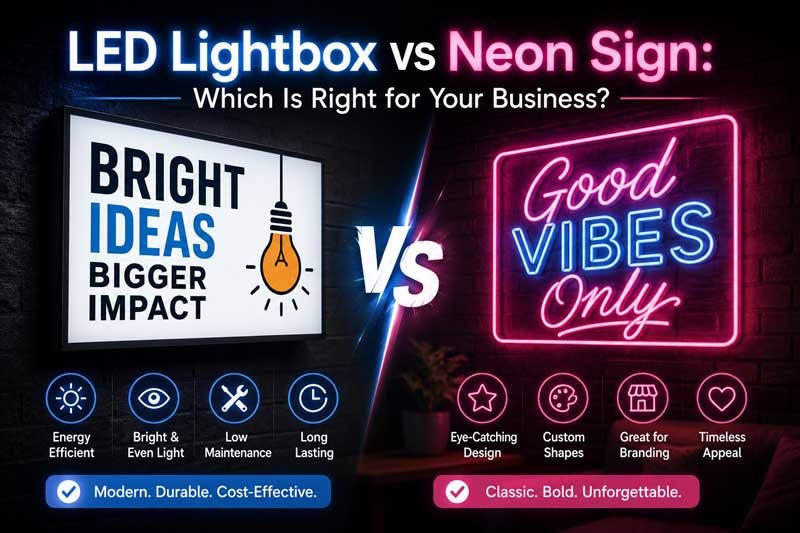
LED Lightbox vs Neon Sign: The Quick Answer
If you want low running costs, durability, and a clean, modern look, go with an LED lightbox. If you want a vintage, artistic glow for a café, bar, or boutique — and you’re okay with higher upkeep — a neon sign (or LED neon flex) is worth the investment.
Most Malaysian businesses choose LED lightboxes for their main shopfront signage. Neon is usually reserved for interior branding, feature walls, or a specific retro aesthetic. Let’s get into why.
What Is an LED Lightbox?
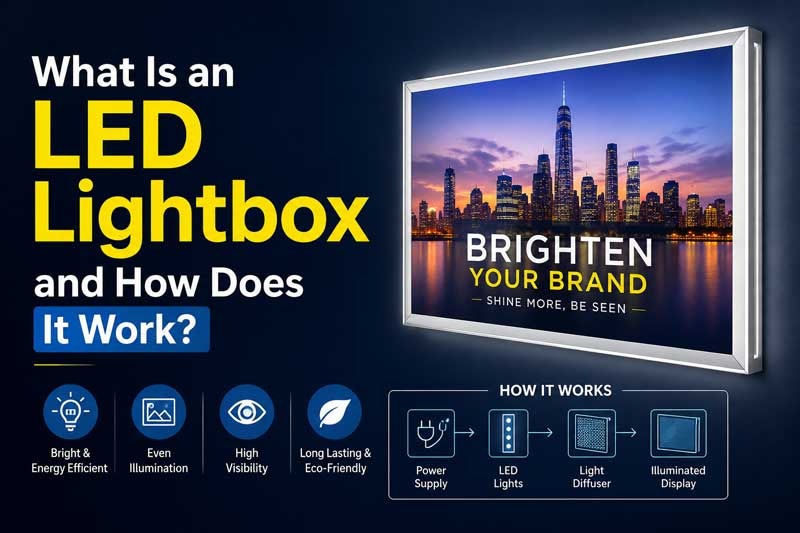
An LED lightbox is an internally illuminated signboard. LED modules sit inside a metal or acrylic frame, lighting up a printed acrylic or polycarbonate face from behind. The result is even, bright illumination across the entire sign — day or night.
Lightboxes come in several forms: slim LED lightboxes, SEG fabric lightboxes, A2/A3 stands, and fully custom outdoor units. That flexibility is a big reason they dominate shopfronts across Selangor, KL, and Penang.
What Is a Neon Sign?
Traditional neon is made from glass tubes filled with neon or argon gas. When electricity passes through, the gas glows with a soft, warm light that’s instantly recognisable — think retro diners, bars, and boutique cafés.
Modern businesses often choose LED neon flex instead of glass. It mimics the neon look using flexible LED strips, which are safer, lighter, and far easier to maintain than real glass tubing.
Cost Comparison: Upfront and Long-Term
Here’s where the decision usually gets made.
Upfront cost: A standard LED lightbox in Malaysia typically runs RM28 to RM40 per square foot for single-sided panels. Custom neon (glass or LED neon flex) tends to cost more per square foot because it’s still largely handcrafted, especially for curved lettering and logos.
Running cost: This is the bigger difference. LED lightboxes draw very low voltage — usually 10 to 30 watts per square foot — and can cost as little as RM20 to RM60 a month to run for a standard shopfront. Glass neon needs far higher voltage to ionise the gas inside the tubes, which pushes electricity costs up significantly, especially if your sign stays on for 10+ hours a day.
If your business runs long hours — think F&B outlets, pharmacies, and 24-hour convenience stores — an LED lightbox will save you real money every single month.
Durability in Malaysia’s Climate
Malaysia’s heat, humidity, and monsoon rain are brutal on outdoor signage.
LED lightboxes use sealed acrylic or polycarbonate panels that resist UV damage and moisture, making them a solid fit for outdoor installations that need to survive year-round exposure. Properly sealed units handle monsoon season without issue.
Glass neon is more fragile by nature. It’s vulnerable to cracking, and outdoor exposure to rain and heat shortens its working life unless it’s carefully weatherproofed. This is exactly why most neon signage in Malaysia is used indoors — interior walls, reception areas, and café counters — rather than as the primary outdoor shop sign.
Brand Image and Visual Style
This is where the choice becomes about personality, not just performance.
LED lightboxes give you a clean, professional, corporate look. They’re ideal for clinics, retail chains, service businesses, and any brand that wants clarity and consistency across multiple locations.
Neon signs carry warmth, nostalgia, and character. They work beautifully for boutique cafés, bars, salons, and lifestyle brands trying to create an “Instagrammable” interior moment. If your brand identity leans vintage or artisanal, neon (or LED neon flex) does something a flat lightbox simply can’t.
Maintenance and Lifespan
LED lightboxes are largely maintenance-free. LED modules are rated for 50,000+ hours of use, and if a section does fail, individual modules can usually be swapped without replacing the whole unit. Graphics on vinyl-faced lightboxes can also be updated without touching the frame.
Glass neon needs more care. Gas can leak over time, transformers wear out, and any glass breakage means a specialist repair — not a quick DIY fix. LED neon flex solves most of this, offering a similar glow with LED-level reliability.
Which One Should You Choose?
Ask yourself three questions:
- Is this for your main outdoor shopfront? Go with an LED lightbox.
- Do you need it running most of the day, every day? Go with an LED lightbox.
- Is this for interior branding, a feature wall, or a specific retro vibe? Neon or LED neon flex is worth it.
Plenty of Malaysian businesses actually use both — an LED lightbox for the main shopfront and a neon accent piece inside, above the counter or on a feature wall. That combination gives you low running costs where it matters most, plus the personality of neon where customers linger longest.
Get Signage That’s Built for Your Business, Not Just Your Budget
Choosing between an LED lightbox and a neon sign shouldn’t be a guessing game. At Elite Sign Advertising, we design, fabricate, and install custom LED lightbox signage and illuminated signboards for businesses across Shah Alam, Klang Valley, KL, Penang, and Johor Bahru — all handled in-house, from concept to installation.