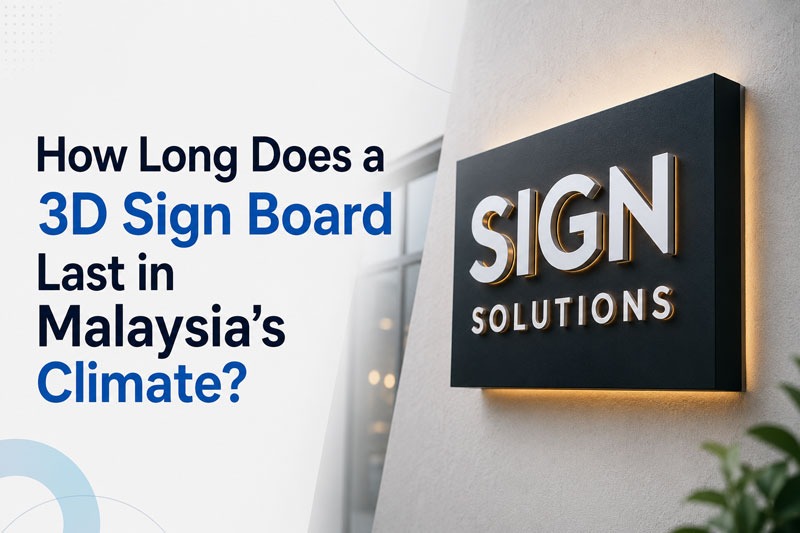
You just invested in a brand-new 3D sign board for your shopfront. It looks stunning. But three years later, the acrylic is yellowing, the LED modules are flickering, and the letters are showing rust at the edges.
That’s not a manufacturing defect. That’s Malaysia’s climate doing what it does best — punishing every material that isn’t built for it.
So before you sign off on your next signboard investment, here’s what you actually need to know about lifespan, materials, and what makes 3D signs survive (or fail) in our tropical conditions.
How Long Does a 3D Sign Board Last in Malaysia — The Real Answer
The honest answer? Anywhere between 3 years and 15+ years, depending entirely on what it’s made of.
Malaysia sits near the equator, which means your outdoor signboard battles daily UV radiation, humidity levels above 80%, monsoon rain, and temperature swings that cause materials to expand and contract repeatedly. That’s a brutal combination — and not every material is designed to handle all four at once.
Here’s a straightforward breakdown by material:
Stainless Steel 3D Sign Board — 10 to 15+ years. This is the gold standard. Corrosion-resistant, UV-stable, and virtually maintenance-free. If you’re near the coast (think Port Klang, Penang waterfront), 316 marine-grade stainless steel is worth the premium.
Aluminium Box-Up Letters — 7 to 12 years. Lightweight, powder-coated aluminium holds up well against rain and UV. The coating can fade after several years of direct sun exposure, but the structure stays solid.
Cast Acrylic 3D Signs (UV-stabilised) — 8 to 12 years. Cast acrylic with proper UV stabilisers resists yellowing and cracking far better than the cheaper extruded alternative. This is the most popular choice for illuminated 3D channel letters in Malaysia.
Extruded Acrylic 3D Signs — 3 to 5 years. This is where businesses get caught out. Extruded acrylic looks identical to cast acrylic at first glance but degrades significantly faster. If you’re quoted a surprisingly low price and nobody mentions the acrylic grade, ask.
ACP (Aluminium Composite Panel) backing — 7 to 10 years. Commonly used as the flat backing for 3D letter installations. ACP is excellent value for Malaysia’s climate — weather-resistant, flat, and easy to replace if needed.
PVC Foam Board 3D Letters — 2 to 4 years outdoors. Fine for indoor or semi-covered applications. Direct outdoor exposure in Malaysian sun degrades PVC foam quickly, especially without a UV-resistant topcoat.
What Malaysia’s Weather Actually Does to Your Sign Board
Most people think about rain when it comes to outdoor signage durability. Rain is actually not the biggest problem.
UV radiation is the real villain. Malaysia receives intense ultraviolet exposure year-round, not just in summer. UV light breaks down polymers in acrylic and PVC, causes colour pigments to fade, and weakens adhesives holding LED modules in place. Signs facing west (afternoon sun) wear out noticeably faster than north or east-facing signs.
Humidity accelerates corrosion. At 80% average relative humidity, any untreated metal — especially at joints, fasteners, and internal wiring points — is at constant risk of oxidation. This is why the quality of internal construction matters just as much as the outer finish.
Monsoon rain creates water ingress. Heavy rainfall forces water into poorly sealed sign cavities, damaging electrical components and promoting rust on internal metal frames. A 3D sign with inadequate IP-rated LED modules and improper sealing can have its electronics fail within two to three monsoon seasons.
Thermal cycling weakens joints. Daytime temperatures in Shah Alam and KL regularly hit 34–36°C, while nights cool to 23–25°C. This daily expansion and contraction cycle stresses the joins between letters, backing panels, and wall mounts — loosening screws and cracking adhesive bonds over time.
LED Lifespan Inside 3D Sign Boards
Illuminated 3D sign boards have two lifespans to consider: the physical structure and the LED lighting system inside.
Quality LED modules are rated for 50,000 hours of operation — roughly 11 years if you run your sign 12 hours a day. In practice, Malaysia’s heat shortens this because LEDs degrade faster at higher ambient temperatures.
What actually kills LEDs prematurely in Malaysian 3D signs:
- Water ingress from poor sealing around letter edges
- Heat buildup inside enclosed letter cavities with no ventilation
- Low-quality LED drivers that overheat during power fluctuations
- Incorrect IP rating — outdoor LED modules need at minimum IP65 for Malaysian conditions
A well-built illuminated 3D sign board using IP65 LEDs with quality drivers in a properly ventilated housing should give you 6 to 8 years before the lighting needs attention.
How to Extend the Lifespan of Your 3D Sign Board
The material is only half the equation. How the sign is installed and maintained determines whether it reaches its potential lifespan — or fails years short of it.
Invest in proper sealing. All external joints, letter bases, and cable entry points should be sealed with UV-resistant silicone. This one step prevents the majority of water ingress failures.
Annual inspection matters. Check fasteners for corrosion, look for early signs of delamination on ACP panels, and test LED sections for flickering — which signals driver failure before full burnout.
Clean it twice a year. Dust, algae, and grime accumulate fast in Malaysia’s humid environment. A mild soap and microfibre cloth clean prevents surface staining from becoming permanent.
Choose the right material for your location. Coastal businesses need marine-grade materials. High-traffic retail shopfronts benefit from stainless steel or cast acrylic that can withstand physical contact. Semi-sheltered indoor lobbies can use lighter materials safely.
Don’t cut corners on installation. Improper wall anchoring causes signs to shift under wind load — stressing internal wiring and eventually cracking letter joins.
Which 3D Sign Material Is Right for Your Business in Malaysia?
If budget allows, stainless steel is the smartest long-term investment. The upfront cost is higher, but you’re unlikely to replace it within your business tenure at that location.
For most SMEs in Malaysia — restaurants, retail shops, clinics, offices — aluminium box-up letters or cast acrylic channel letters with UV-stabilised faces hit the sweet spot between cost, appearance, and durability. Expect 8 to 10 years of solid performance with basic maintenance.
Avoid extruded acrylic and uncoated PVC for any outdoor-facing installation. The cost saving isn’t worth the 3-year replacement cycle.
The Bottom Line
A 3D sign board in Malaysia doesn’t have a single lifespan — it has the lifespan you build into it through material choice, construction quality, and maintenance.
Choose premium materials. Insist on proper sealing. Work with a signboard maker who knows the difference between cast and extruded acrylic, uses IP65-rated LEDs, and builds for tropical conditions — not just tropical-looking aesthetics.
Your sign is often the first thing a customer sees. It deserves to still look good five years from now.