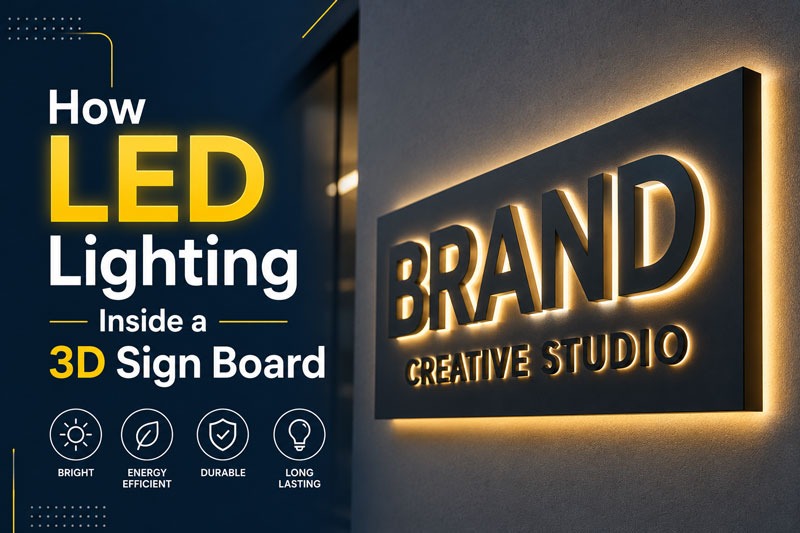
If you’ve ever walked past a glowing shopfront at night and wondered how those bold, dimensional letters light up so evenly — you’re looking at LED 3D sign board lighting explained in real life.
It’s not magic. It’s engineering.
Understanding how the lighting actually works inside a 3D sign board helps you make smarter decisions when ordering one for your business. Whether you’re opening a café in Shah Alam or a retail outlet in KL, the lighting type you choose determines how your brand looks, day and night.
Let’s break it all down.
LED 3D Sign Board Lighting Explained: The Core Structure
Before we talk about lighting, you need to understand what’s happening inside the sign.
A 3D sign board — also called a channel letter sign or box-up sign — is not a flat panel. Each letter or logo element is individually fabricated as a three-dimensional shape. Think of it as a hollow metal or acrylic box in the shape of your brand name.
The structure has three main parts:
The face — the front surface, usually made from translucent acrylic. This is what customers see.
The returns — the side walls that give the letter depth and that signature 3D effect. Typically made from aluminium.
The back panel — the rear of the letter, which connects everything together and houses the LED components.
Inside this hollow channel is where the LED modules sit. The LEDs are wired to an external power driver, which is usually mounted behind the sign or inside a weather-proof casing.
This is the foundation of every illuminated 3D sign board in Malaysia.
The Three Main LED Lighting Types for 3D Signs
Here’s where it gets interesting. Not all LED 3D signs light up the same way. The positioning of the LEDs inside the channel creates entirely different visual effects — and each serves a different branding purpose.
1. Front-Lit (Frontlit) — Bold, Bright, Impossible to Miss
Frontlit is the most common LED channel letter sign type you’ll see on shopfronts across Malaysia.
The setup is simple: LED modules are mounted inside the hollow letter, facing forward. The light travels directly through the translucent acrylic face and out toward the viewer.
The result is a bright, high-visibility glow. The face of the letter lights up in your brand colour — red, white, blue, yellow — whatever you choose.
This is the go-to option for:
- Busy roadside shopfronts with fast-moving traffic
- Businesses that need to be seen from a distance (30 to 50 metres or more)
- High-competition commercial areas like shop lots in Subang, Petaling Jaya, or Johor Bahru
One important detail: the colour of the acrylic face determines the colour of the light output. If you want bright red lettering at night, the acrylic sheet is red. The LED inside can be white — the coloured acrylic does the filtering.
2. Backlit (Halo-Lit) — Elegant, Sophisticated, Premium Feel
Backlit 3D signs — also called halo-lit or reverse-channel letters — work in the opposite direction to frontlit signs.
Here, the face of the letter is solid and opaque, usually brushed aluminium or stainless steel. The LEDs are mounted inside but face backward, toward the wall behind the sign.
The letters are installed with standoffs — small metal spacers that push the sign away from the wall by roughly 2 to 5 centimetres. This gap is critical. The light escapes through the back, hits the wall surface, and bounces outward around the edges of each letter.
The effect? A soft, glowing halo that outlines every letter.
It looks premium. It looks architectural. And it works beautifully for brands that want to feel high-end.
Best suited for:
- Hotel entrances and corporate lobbies
- Premium retail boutiques and salons
- Office facades where a refined, upscale look matters more than raw brightness
One thing to note: halo-lit signs work best on light-coloured, smooth wall surfaces. Dark or highly textured walls absorb the reflected light and reduce the halo effect significantly.
3. Dual-Lit (Front + Back) — Maximum Visual Impact
If frontlit signs are bold and backlit signs are elegant, dual-lit signs are both at once.
This lighting type uses LEDs that illuminate both the front acrylic face and the back wall simultaneously. The result is a layered effect — bright, colourful lettering on the face combined with a soft halo glow around the edges.
Some dual-lit signs use two different LED colours for added contrast. For example, white front lighting with warm amber back lighting creates a striking interplay that draws attention from multiple viewing angles.
Dual-lit 3D signs are popular for:
- Hotel main signage (as seen commonly in KL’s hospitality strip)
- Entertainment venues, restaurants, and event spaces
- Any brand that wants a statement sign that stands out day and night
The trade-off is cost and complexity. More wiring, more LED modules, and a slightly longer fabrication time. But for high-footfall locations, the investment pays off quickly.
What Type of LED Modules Are Used?
Not all LED strips are equal. The quality of the LED modules inside your 3D sign determines brightness, colour consistency, and longevity.
For 3D channel letter signs in Malaysia, SMD (Surface-Mounted Device) LED modules are the standard. These are small, flat LED components mounted in clusters and positioned at regular intervals inside the letter channel.
A few specifications worth knowing:
Brightness (Lumens/Nits): For outdoor 3D signs exposed to Malaysia’s direct sunlight, quality LED modules output 800 to 1,000 nits or higher. This ensures the sign remains visible during the day, not just at night.
Colour Temperature: Warm white (around 3,000K) gives a softer, warmer tone. Cool white (5,000–6,500K) is crisper and more clinical. Coloured LEDs (red, blue, green, RGB) are matched to brand requirements.
IP Rating: For outdoor signs, LED modules should carry a minimum IP65 rating — meaning they’re protected against dust and water jets. Malaysia’s tropical climate demands this as a baseline, not a luxury.
Lifespan: Quality LED modules in a well-maintained 3D sign can last 50,000 hours or more. That translates to well over a decade of nightly operation.
The LED driver (also called the power supply or transformer) converts mains electricity to the low-voltage DC current the LEDs require. Choosing a weatherproof, appropriately rated driver is just as important as the LED modules themselves.
Why LED Is the Right Choice for 3D Signs in Malaysia
A decade ago, some 3D signs still used neon tubes or fluorescent lighting inside the channels. Today, LED has completely taken over — and for good reason.
Energy efficiency: LED modules use a fraction of the electricity that neon or fluorescent alternatives consume. For a business running signage 12 hours a day, the electricity savings add up significantly over months and years.
Heat output: Neon tubes generate substantial heat, which accelerates wear on the surrounding acrylic and aluminium. LEDs run cool, extending the life of every component inside the sign.
Maintenance: Neon tubes are fragile and expensive to replace. LED modules are robust, and if one cluster fails, only that section needs replacement — not the entire lighting system.
Design flexibility: LEDs can be programmed for dimming, colour-changing effects (with RGB modules), and timed switching. For dual-lit or decorative applications, this opens up creative options that older lighting technologies simply can’t match.
Weather performance: In Malaysia’s humid, high-rainfall environment, LED technology with proper IP-rated enclosures outperforms every alternative in long-term reliability.
Choosing the Right Lighting Type for Your Business
Here’s the honest answer: there’s no single right answer. It depends on your brand identity, your location, and your budget.
If your shopfront faces a busy road and you need visibility from 30 metres away, frontlit LED 3D lettering is your strongest option.
If you’re fitting out a corporate office lobby or a premium retail space where the aesthetic matters as much as the visibility, backlit halo-lit signs create an impression that frontlit signs simply don’t.
If you want both — and you have the budget for it — dual-lit 3D signs deliver the most complete visual impact of any option available.
At Elite Sign Advertising, we help Malaysian business owners work through exactly this decision. Every sign we fabricate starts with understanding your business first — your location, your brand colours, your customers, and what you need the sign to do.
Final Thoughts
LED 3D sign board lighting is one of those things that looks simple from the outside but has a lot of engineering behind it. The type of LED setup inside — frontlit, backlit, or dual-lit — completely changes the look, feel, and effectiveness of your signage.
Getting this right from the start means your sign works for your brand every single day, not just on the first week after installation.
If you’re planning a 3D sign board for your business in Malaysia and want to understand which lighting approach suits your shopfront, speak to our team at Elite Sign Advertising. We’re based in Shah Alam and serve businesses across Selangor, KL, and nationwide.